Followers

Showing posts with label time management. Show all posts

Thursday, November 1, 2012

Time Matrix, Quadrant II


Why is it that we neglect some of the most important things in our lives?  We treat strangers better than our own families and loved ones?  Why is it that the book we want to read, the trip we wish to take, or some other event that we want to do gets pushed to the side.  I’ll do that someday…  When I get the new job, when the kids grow up, when……..

My answer is simple, because these items are important, but not urgent.  There are no deadlines.  No rush.  Important but not urgent = Quadrant II.

Steven Covey covers all of this in his book, Seven Habits of Highly Successful People.  However, I’ve been trying to live and do things I’ve read and done.  So this is from my perspective.

Things in Quadrant II are:
*Preparation
*Planning
*Prevention
*Relationship Building
*Personal Development

The reason things don’t happen here often is because we can always do it later.  I have seen this sign many times in different offices:


“Lack of planning on your part does not constitute and emergency on my part.”


Being prepared, planning, prevention, all take some time; there is an opportunity cost.  Several years ago I had a discussion with one of my sons.  He had started collage, and there was a lot he wanted to do.  I was trying to impress upon him the importance of good grades.  He told me so many people wanted so many things, how do you do it?

The cost of getting good grades is not doing some of the fun things until you get the school things done.  That is called an opportunity cost.  An opportunity cost is two activities that happen simultaneously.   Doing one activity instead of the other activity is the cost.  Go to the movie, or study for the test.  Going to the movie is the choice, the opportunity cost for attending the movie is a low score on the test.  And vice versa.  This is also balance in life. 

The goal is to reduce stress in life.  Find happiness.  Find peace, fulfillment and a dozen other things I could name.  Stay out of Quadrant I, or enter Quadrant I prepared.

So block out time to plan your day or week.  A strong fulfilling relationship just doesn’t happen.  Personal Development is no accident.  What is the opportunity cost of not planning, not being prepared?  A lot of stress. 

When I have done what I’m about to explain, I find my life is less hectic.  Unfortunately, I have not followed this advice lately and I am feeling the effects.  So I am committing to do this again, to find that balance in my own life.  This post is as much for me and I share with you.

First of all make the time to plan.  There is at least an hour or two a week where you can sequester yourself with yourself and think.  Thinking is very important.  It is hard work.  People view physical labor as work, but thinking is work, and it can be very productive, if the thoughts become actions…

Write down what needs to be done that day or that week.  What meetings do you have?  What deadlines are looming, what needs to be done for a class, your boss, your loved one?  What can you do to make it better?  When will these things be done?  When will you read that book?  I never read a book in one sitting.  You can find a moment here and there to read.  Eventually the book is read. 

Find reasons to get things done.  Do not allow yourself to make excuses for why you are not getting things done, eliminate the activates that are stopping you from doing the things you want to do.  Identify the time wasters in your life and take steps to eliminate them.

As you do the quadrant II preparations you’ll find the stresses and urgent interruptions will lessen.  It is a lifetime of working.  There have been times in my own life where I was really, really good at doing the planning and execution.  Currently I am not as good as I’d like to be.  So I am working on getting back there again.  When I’ve done the Quadrant II things, my whole stress level is lower, and my relationships are better.  Life is better.

If you want to change things in your life, you must first look at what you need to change within yourself.  You can only control you.  You can affect and effect others and things, but you cannot control them. 

What have you found useful for effective planning?

Thursday, October 25, 2012

Time Management Matrix: Quadrant I - The Stress Zone


Deadline has passed, phone is ringing, someone is trying to talk to you right now, and a crisis is brewing that needs attention right now to keep from blowing up.  You have entered the stress zone.

Life has stress in it, but living with constant stress is not an option most of us would want.  Quadrant I is the pressure point of the Time Management Matrix.  Things here are urgent and important.  These issues must be dealt with right now.  Sometimes life has to be dealt with right now. 

I am a firm believer in being proactive.  Quadrant I is just the opposite, this is a reactive area.  The reason people end up in this quadrant could be lack of planning, lack of foresight, or procrastination or spending too much time in Quadrant III or IV. 

We all have meetings we have to attend, deadlines to meet, and have pressing issues.  However, the stress levels of these issues depend on how well prepared we are for the meetings and deadlines.  Procrastination leads to a lot of stress.  Next week I’ll talk about Quadrant II.  The more time we spend doing Quadrant II themes, the less time we spend stressed.  Stress free is a good goal. 

I have found in my own life when I procrastinate things, or fail to use my time wisely I end up in Quadrant I unprepared and stress.  I enter quadrant I every day, but if I am prepared for the events then my stress level is much lower.

So are you ready for your entry into Quadrant I?  What do you do to lessen your stress?

Thursday, October 4, 2012

Introduction to the Time Matrix

Last week I had a reminder about some time management items, and I got to thinking about them.  I remembered about the Time Matrix.

You remember math and plotting and quadrants and all?  Well believe it or not there is a Time Matrix as well.  Steven Covey talked about it in his book 7 habits of highly successful people.  If you get a chance read that book, it has a lot in it...

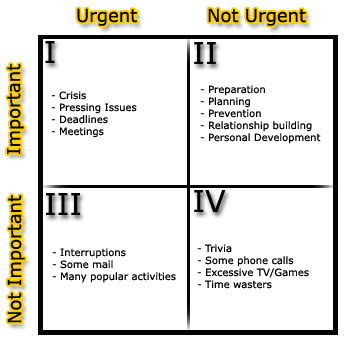
So on the horizontal axis we have things that are urgent, and not urgent.  A phone ringing is urgent, must be answered like, now.  Not urgent is reading a novel.  The book just sits there until it is picked up and opened.

The vertical axis are Important and Not important.  So it looks something like this


There are four quadrants.  Important/Urgent = Quadrant I  A very stressful place to be.  Things have to be done right now!

Urgent/Not Important = Quadrant III.  These things interrupt your routine, your well laid plans. How you view things, some of them could become quadrant I issues, but if they are not important they eat up your allocated time to complete something else.

Not Urgent/Not Important = Quadrant IV.  Things that are good, we all need down time, but if we do too much of them we find ourselves wasting time, and our productivity goes way down and we find ourselves not getting anything done we would like to.  However we are having a great time until things fall into Quadrant I and we are back to getting stressed.

Not Urgent/ Important = Quadrant II.  This is the important place, this is where things get done, relationships are built, where things that matter happen.  Time spent here makes our lives rich and fulfilling. However, because these things are not Urgent they can be done later.  A lot of my blogs have been on motivation and relationships and things that matter.  I believe working and living in Quadrant II is important.  I find that the demands on my time pull me into quadrant I and stress more often than I would like.  Over the next several weeks I plan on exploring each of these quadrants and give my own personal input from my own life experiences.

Again Steven Covey's book covers these in great detail.  I just use this as a resource.  I want to be sure I give credit where credit is due.

So draw your quadrants out and list the things in your life that fits in each of those quadrants. Ask yourself where you spend most of your time?  Where do you want to be?  How will you get there?  Oh, yes, that is a Quadrant II activity, isn't it?

Wednesday, November 2, 2011

LISTMAKER, LISTMAKER, MAKE ME A LIST - Guest Post

Today's guest is Mindy aka Big Black Cat 97 or BBC to her friends over at AQC. She is one of the moderators over there, she blogs over at Writer, Writer, Pants on Fire. She also contributes to the blog, From the Write Angle.

I'm grateful that she agreed to do a guest post here. She has an agent and is actively seeking a publisher for her book. I'll let her tell her own story. So here is BBC.


LISTMAKER, LISTMAKER, MAKE ME A LIST

I’m slightly OCD. It’s one of the qualifications for librarianship.

OK, not really, but I find that the hyper-responsibility side effects are valuable in all three venues of my life – home, work, and writing career.

I could spend every hour of each day on one of these aspects, but that would mean the other two falter and die. The first type of death means that no one in my household eats or has clean clothes. The second would translate into a pile of books on the bookcart and hundreds of cranky, panicked teenagers. The third means no forward motion towards my goal of publication. None. No new blog posts, no networking tweets, no AQC downtime, and definitely no additional word count on the WIP.

None of these things are acceptable.

So I give a little to all three each day, and the only way to keep myself straight on what needs to be done is by taking a very simple, yet highly effective time-management step. I make lists.

I use a Stickies program on my laptop to manage my three-ring circus. The yellow sticky lists my household duties for the day, which I try to manage one thing at a time. Monday is vacuuming, Tuesday dusting, dishes are done every other day and laundry waits for the weekend. The pink sticky directs my attention to the most pressing needs in the workplace, listed by priority. The wall above my desk serves as a big-picture amalgamation of stickies telling me what needs to be accomplished long term.


Interesting genetic factoid: my sister (also a co-worker) pointed out that the wall above our Dad’s desk at the homestead looks exactly the same.

And lastly, my green sticky tells me what I need to be doing in writing-career land. And it doesn’t say – HEY YOU! WRITE A BOOK! There are many ways to keep the literary brain cranking, and I need quiet and uninterrupted stretches of time to nail down that WIP.

So what does the green sticky say?

It has links to various web pages that are helping me out with my research, so that I can easily hit up information during short downtimes. There are reminders about critiques that I need to get back to betas, ideas for blog posts, names of people I want to contact for interviews, and titles of books that I want to read and review.

Sounds like a lot, but all of those little steps are furthering me down the path of my writing career, and they can be addressed during the brief moments during the day that chance sometimes allots to me. I guess in the end that’s the secret to my time-management; knowing to address the little goals during little moments, and constantly reminding myself that the big goal for the evening is to crack out another 1k.

The other secret isn’t such a secret – don’t be lazy.

Sure, I’d rather watch Firefly reruns sometimes, but I’m reminded of a sports t-shirt I had in high school that read – “Whenever you are not practicing, somewhere, your opponent is, and when you meet, s/he will win.”

I might not actually wear a t-shirt that says, “Somewhere another writer wants to watch Firefly too, but they’re writing instead. And they’re published.”

But you get the idea.

Thursday, October 6, 2011

Thrusday's Time Tip: Organization vs. Spur of the Moment

It is now football season. Friday night high school football, Saturday Collage Games, Sunday NFL football, are all in full swing. Locker rooms are telling. One coach noted that the offensive line players, their lockers are neat and very tidy. The defensive players lockers are … chaotic, almost without fail. Interesting phenomenon. When you stop and look at things it does make some sense. The defense is reacting to what the offense does. The offense has a plan, a strategy, a way of doing things. Thus the players tend to have places for things and order. The defense reacts to what the offense is doing; their life is a bit more chaotic.

Up to now I’ve been blogging about the best use of time, values, and management tips. All of these are very important. Especially if you are trying to get organized, be efficient, or attempting to accomplish goals. We are planning our offense.

I want to throw something else out there for you to mull around. Don’t be so ridged that you can’t take an opportunity to stop and smell the flowers, to use an old metaphor. This is almost a complete contradiction to what we’ve been working towards. Chaotic elements, but that is what life always does: life is what happens when you are making other plans.

A few weeks ago I posted about a labor day weekend, The Snapshot. If you haven’t read it, please take a moment to follow the link and read, and leave a message. Sometimes we are so busy and working so hard to get things done that life passes us by. We find we miss out on some of the really important things.

So you may want to add some flexibility into all of your planning and managing. Someday the wind will be just right to go and fly a kite. Take a look at what you’ve got, rearrange things and take the moment to fly that kite. You’ll take some time to build memories. I am so grateful my wife and I decided to take a day and go to the beach. It was a wonderful day, and even more wonderful because of the tragic events that happened a week later. I am grateful that we took the time to go and have some fun. So if the urge strikes to fly a kite, run to the beach, go out for lunch, stop in and visit an old friend, or do anything else that “isn’t in the plans” let the plans go, rearrange, reschedule, take the time to do a spur of the moment whim.

Yes, make plans, manage, but be prepared to make changes, but try to focus on what matters most. When life is all said and done, I don’t think anyone will wish they spent more time at work, or more time on their projects. Family and friends are why we spend the hours at work and on projects. To earn the income to live life. Take the opportunities to make great memories.

Thursday, September 29, 2011

Riley’s Handy Dandy List

Today Riley Redgate is my guest here on The Write Time. I am blogging over on The Mighty Jungle today.

I met Riley Redgate over at AQC, I was fortunate to have her critique my query when I put it up for review. It wasn’t sugar coated, but it was well said. So as I learned more about her the more impressed I became. Here is a bit of what I've pieced together about Riley: She is a competitive piano player; in a service club, leads an a cappella group, runs cross country, manages/acts with a theatre troupe, She is valedictorian, and right now she has two mss in the works and one steaming up in her brain that's crying out to be written! She claims to never sleep. I tend to believe that based on the time stamps on some of her comments on AQC!

Go check out her blog In The Jungle.

I told her she was a prime candidate to post on my blog, she has accomplished a lot. So here is Riley!

First of all, big thanks to Dean for inviting me here! Perhaps writing about time management will ... er ... make me better at it. Because yep, that's right, I'm not an epically efficient time wizard.

Actually, funny story! I used to be an epically efficient time wizard. Back in middle school, oh man, I was so good at time management. I had schedules for myself. I had blocks of time set up for 1) homework, 2) piano practice, 3) sports practice (soccer, tennis, softball), 4) rehearsal, 5) hanging out with my friends every so often, 6) reading, and 7) necessary bodily functions.

Just kidding. I didn't plot out my necessary bodily functions. I was/am a little neurotic, sure, but not THAT neurotic...

Anyway. Notice what's missing from that handy-dandy list?

Oh yeah, that's right. WRITING. My high productivity levels met a swift and messy end when I discovered something I enjoyed doing that took up tremendous blobs of time. And it was just a vicious cycle from there, believe me. Here's a little how-to guide for emulating my sophomore year (for those of you with whom I'm unacquainted, that's two years ago):

Step One: Get home from school; spend time writing.
Step Two: Start homework far too late; work into the wee hours of the morning.
Step Three: Wake up bleary and exhausted.
Step Four: Slog through school.
Step Five: Come home and spend time writing ... but since I'm exhausted, this takes far longer than it should.
Step Six: Start homework at midnight; spend hours doing what would have taken half an hour had I slept more the night before...
Step Seven: Wake up dead.
Rinse and repeat.

You can imagine how much fun that was! Yeah, not at all. But that's okay - I've come up with an easy, fun, perfect solution.

I have a pretty busy existence. Here's some quick math - every Monday through Friday, I have:

-cross-country practice for twelve-and-a-half-ish hours
-rehearsal for twelve-and-a-half-ish hours
-school for forty hours
-piano for two or three hours; chorus is the same.

So that's 70-ish hours absorbed out of 120 available hours. Subtract eating (I don't eat breakfast; so let's say a small 2.5 hours for food) and general hygiene (2.5 other hours) and I have 45 hours left to play with. According to my father, teenagers are supposed to have 9 and 1/4 hours of sleep a night (HA HA HA yeah right). That's already not feasible; that would require 46 and a fourth hours.

What's the easy, fun, perfect solution to this mathematical paradox, you ask? Where's the writing time coming from?

Tricked you! I was kidding - there is nothing easy, fun, or perfect about having to carve time out of nowhere to do the thing that calls your name 24/7.

What I do know is that going a day without writing would be more frustrating than going a day without food. And... er, yeah, I'm well aware that sounds WAY overdramatic, but it's no exaggeration. Eating doesn't give me any sort of spiritual fulfillment or intellectual satisfaction. After eating, I don't feel like I've gained anything or done anything of worth. Writing, on the other hand, is my outlet. It's what I wait for during those 8 hours of school and 2 hours of running and 3 hours of rehearsal. So yes, I'm willing to sacrifice sleep for it.

Weekends are another matter. More specifically, weekends are heaven. Provided I don't have too much homework, I will sleep and write and sleep some more and lounge around being slothlike and then writewritewrite.

Usually, though, it's a struggle. But hey - you give some, you get some. Personally, I'm way happier having lost bunches of sleep and gained a novel than I would be if I'd just been well-rested all the time.

That said, I don't budget writing time only out of my sleeping hours. I plan characters during my lunch period (yeah, I'm that weird girl scribbling in her car during lunch break), plot while I'm running my cross country workouts, and if a class is being particularly useless... well, I may just find an alternate activity. I maximize the output of every second I can get.

It's a big question, whether we're willing to give up normal activities (i.e. sleeping) for writing, especially when we're in the 'thankless' stage of the process (unpublished, unagented, un-everythinged). But in my opinion, writing is all about risk. How much time am I willing to give? How big a plot am I willing to write? How daring is my concept? Can I really sacrifice sleep and energy for the novel brewing in my mind? We have to put everything we've got on the table, write with reckless abandon. And sure, maybe it's reckless to abandon the conventions of studenthood to stay up typing and retyping the same sentence into Microsoft Word, debating whether the use of passive voice is appropriate here, wondering if my characters are well-rounded enough. These are not problems for normal people.

I guess I'm fine with not being normal.

Thanks again, Dean, for having me! Write on! =]

Thursday, September 22, 2011

Guest Blogger Cat Woods on TIME® MANAGEMENT

Today's blog post is by guest blogger Cat Woods. Yes, she is another friend I've made over at Agent Query Connect. She has a fantastic blog called Words from the Woods (My favorite post on her blog was about her computer in need of protection.) She is a great writer, and has a fantastic blog. Check it out, but remember to come back here!

So anyway, I asked Cat if she'd like to be a guest blogger, so yes, we are doing a blog swap. I've got to think up something to say for her, but since my compters are all on the fritz she hasn't given me a firm deadline, yet...

So Here is Cat.


First I'd like to thank Dean for asking me to guest post on his blog. One of the reasons I'm so impressed with the invitation is that Dean is organized and writes a blog on time management. I, however, am not. Organized or good at time management.

On the outside, I'm pretty unruffled. Yet when you peek inside, you'll note that I'm a bit of a mess. I've forgotten to drop my kids off at school. I've told my kids I'll pick them up in five minutes and remember this promise two hours later. I'll lose track of time and realize at 5:28 that the hamburger is still frozen for dinner--scheduled to be eaten at 5:32.

But before you call social services on me, hear me out.

I'm learning to better manage my time thanks to the handy invention of a timer. You laugh, but the end result is that I no longer forget my children AND I'm more productive by the end of the day.

Here's the method to my madness.

I plug every, single, little thing into my google calendar and assign events multiple reminders based on how much time I will need to prep for said event. As the day progresses, my phone will chime a beautiful reminder and my computer will concur. I then calculate what I need to get done and how much time I have left to do it in. This is where the microwave comes in.

I set the timer. Sometimes both the microwave and the stove. Then I get busy. I use this specific chunk of time to write, or any derivation, thereof. The adrenaline kicks in and nudges my creativity. "Hello," the downward spiraling numbers seem to say, "you only have forty seven minutes and sixteen seconds to get that scene done. Oh wait...forty seven fifteen, forty seven fourteen, thirteen, twelve...."

This time constraint works for my otherwise-wandering mind and keeps me focused on the task at hand.

But what about the days I have nothing planned beyond the mundane housework, work out and meal prep and the not-so mundane writing, reading, social networking and editing?

Not having specific events scheduled in an eight hour period turns me into a labrador puppy with a bad case of ADD. I sniff my way from project to project, getting side-tracked upon side-tracked. Before I know it, the day is over and I've followed various links so deep into the cyber sphere I could tell you when the first case of documented toilet paper use was (589 AD in China) and what some of the more unseemly substitutions were (you don't want to know). Strange when you consider I started hours earlier by looking up the definition of pugnacious.

On these days, the washing machine nicely breaks up my day and helps me keep on task. Throw in one load of laundry and blog. When the buzzer goes off at the end of the cycle, switch gears. In this way, I move throughout my day of writing and real life, succeeding at both endeavors.

And if I fail to hear the laundry buzzer, it's usually because I got wrapped up in my writing or editing, in which case all is forgiven because I'm on a roll.

Oops, gotta run. The microwave is calling my name.

Thanks, Dean!


When Cat Woods isn't chasing dust bunnies or raising her family of seven (1 dear hubby, 4 fabulous kids and 2 hunting labs), she writes juvenile lit. She's penned everything from warm and fuzzy board books to dark YA. You can find her at Words from the Woods, where she blogs about her writing journey.

Tuesday, July 19, 2011

All About Time and All About Writing - Guest Blogger Greenwoman

Greenwoman was one of my first "fans" for my blog. She kept hounding me to get my blog going. I'll not give the phrase she said, it is a bit, risque. She has a whole guest blogger thing going on over at her blog. (Which gave me the idea of having guests for my blog.) I believe she is the source of the Meme's that are going around! I am happy she agreed to swap blog posts. So Thursday has arrived on Wednesday. You can read my post over on Greenwoman's blog. I'll also be on Cherie's blog this Friday.

Take it away Greenwoman!

SO, Dean has this fantastic blog all about writing, and time management. This is a good subject!

I have a confession to make. I'm TERRIBLE at time management. It isn't because I don't know how to do it--I've read an entire self-help section's worth of time management advice. The problem is that I am undisciplined. No, that's not true. It's worse than that. I'm REBELLIOUS.

"Well then," you're probably saying to yourself, "it's a good thing she doesn't have to work for someone else."

Well yes . . . and no. No, because it means I have no one to feel rebellious toward besides myself. (I imagine there's medication for this. I'm afraid to take it. It might make the voices in my head go away.)

SO, in order to get my writing done, I have to trick myself.
I figure I can do anything for 15 minutes at a time. I can even listen to my kids talk for 15 minutes. So, I employ a timer and a reward system to stay focused. (The reward is usually something like spending five minutes goofing around on twitter or making another cup of tea. I am a simple creature.)

I started using the timer method during NaNoWriMo (http://www.nanowrimo.org/) a few years ago. My writing buddy and I would have "word wars": 15 minutes on the clock, type as much as you can, the one with the most words wins. Okay, so you don't win anything, except an opportunity to feel smug. But you take what you can get. After a session was over, we'd spend some time chatting and comparing notes, shake out our wrists, and then do it again.

I wrote 100,000 words in 30 days--all in 15 minute increments. And the thing is, my family barely even noticed I was participating in NaNoWriMo. With short bursts of intense focus, I managed to get my daily writing done in one or two hours instead of sitting in front of the keyboard from morning 'til night.

Over the past two years, my writing buddy and I have inched our sessions up to 30 minutes. Longer sessions are a good idea when editing--it's hard to get editing done in 15 minute increments. And these days, sometimes our check in will go like this:

Me: "Time! How'd you do?"
Laura: "Good! I'm getting this chapter rearranged. You?"
Me: "Good, I'm on a roll. Want to jump back in?"

And off we go again. Sometimes, we even work WITHOUT a timer. Like when we write at a coffee shop or the library.

But sometimes when I'm working alone, I need to go back to 15 minutes. It's a way of psyching myself out. "Yes, I have 4500 other things I also need to do today. So I only have to concentrate on writing for 15 minutes. Then I can do something else."

Usually I only need the timer once. Because usually the real issue is getting my butt in the chair to work, and once I'm there, I don't want to stop.

I use a simple kitchen timer, but there are some options out there for writers like Write or Die (http://writeordie.com/).

The great thing about living by the timer is it makes everything feel more like a game. Sometimes I even use the timer for less pleasant tasks than writing. Tasks like cleaning. But let's not talk about that: I'd rather be writing.

Saturday, July 16, 2011

Sophie Perinot talks about her new book, and how she finds time to write.

I’m excited about the new aspect of my blog. Guest Bloggers. I have several writing friends I’ve made at AQC willing to post, and some friends I’ve made on twitter. All writers, all with demands on their time. They will share their insights to writing and managing their time.

My first interview is Sophie Perinot who is about to publish her first book The Sister Queens. She has all the details on her blog

I met Sophie Perinot aka “Lit_Gal” over at Agent Query Connect (AQC) in some of the forums and in the Wednesday night chat room. She strikes me a very savvy and astute individual. Her posts in the forums are always informative and polite! I read many genres of books and I enjoy historical fiction. I write high fantasy and love medieval times. I admire historical fiction writers, because of the amount of research they need to do for the backdrop of their stories. Not an easy task. Research, writing, and blending it all together.

Overall writing takes a lot of time. So I asked if she would help me with a blog post on how she manages her time, successful writer that she is. She agreed to do a question and answer. Here is her interview.

Welcome to The Write Time Sophie.

First let me say I am delighted to be here on “The Write Time.” This is my first foray into blog interviews and I am glad to have a fellow AQConnect member on the other side of the virtual microphone. Now back to business.


What led you to writing historical fiction?

Historical Fiction was pretty much pre-destined to be my niche. I’ve been a life-long student of history (my undergrad degree is in history) and I come from a family of complete history nerds (my sister is a professor of history, my husband was a history major, my oldest child who has just started college is studying Art History. . .I could go on). As someone who studied French in abroad, and who is a hopeless devotee of Alexandre Dumas, père, French history was a logical starting point. So the manuscript that hooked my wonderful agent was set entirely in France, and the manuscript that sold to NAL and will hit shelves in March 2012 takes place about fifty-percent in France.


What time period, and location are your favorite?

I don’t have a favorite time period, except very broadly—13th century to 17th century—but I write books set in Western Europe. The novel I am working on now will again be set in France (16th century), but I have a project set in Italy planned as well.

How much time do you spend on research?


Lots :) But writers of historical fiction do have to be careful not to be sucked into research to the point where books don’t get finished. We are not writing academic history and the publishing schedule (the time span between publication dates for individual books) seems to be getting tighter in our genre. If you spend ten years researching each book it is hard for me to imagine making a go of it in publishing at this time.

I remember back at my very first Historical Novel Society Conference in 2005, the keynote speaker was Jack Whyte. During his address he said something that really stuck with me (and I am paraphrasing here because it’s been years) – “if your main character needs to do battle using a sword, by all means find out what type he would have used but you don’t need to learn how to forge one from scratch.”

What gives you story ideas?

One of the great things about writing historical fiction is that history is full of the fascinating, the bizarre, and the profound. It is a treasure trove of ideas.

Very often as I am researching I will come upon a fact or an event that makes me think, “wow, you couldn’t make stuff like this up.” So, I keep an eye open for ideas for future projects while I work on current ones. For example, the idea for my novel, The Sister Queens, came from a footnote in a history of Notre Dame de Paris that I was reading for a 16th century project -- a footnote about Marguerite of Provence, whose kneeling image is carved over that great church’s Portal Rouge, and about her sisters. I had never heard of these remarkable sisters from Provence and wondered how such extraordinary women could have largely slipped through the fingers of history. I started a folder with their names on it and began ruminating on ideas for a book about them.

Beyond the historical events included in my novels, the themes often come from my own life. I think the most important questions that we ask ourselves as human beings haven’t changed substantially in a thousand years. For example, One of the secondary themes in my current book is what does it mean to be a great man? Is professional competence the most important measure of “success?” Sometimes it can be more interesting and less “threatening” to examine “big issues” when they are removed from our everyday context and allowed to play out in the more remote setting of history.

When do you write?

Unlike many folks who are trying to do all their writing after hours, I have the luxury of daytime writing. All of my children are in school full time, so I can usually manage some time in my “writing lair” during the heart of the day. I don’t tend to write on weekends when my kids are home unless I have a deadline (I never miss deadlines – it’s a matter of personal pride for me). When I do have a deadline then weekends and even vacations or holidays are just “extra work days.”

When I am gripped by my muse I can (and do write any time and any where). I sometimes dictate portions of my work into a hand-held voice recorder. That gives me a lot of flexibility and allows me to “steal moments’ for writing. As a result, I’ve written sections of a book in the car and in the frozen food section of the grocery. I’ve also been known to get up in the middle of the night and creep off somewhere to dictate in the dark, lol.

How much time a day do you spend on your writing?

I consider “writing” to be all aspects of the process of getting a book to market – researching, writing, editing, and even some social networking or blogging (which falls under marketing). When you roll all that together I would say I try to spend at least 5 hours a day on my writing on weekdays during the school year. In the summer writing is more difficult.

How do you balance your writing with other aspects of your life?

When I first started writing it came second to pretty much everything else in my life. I was treating it like a hobby. I quickly realized, however, that if I wanted writing to be a job I had to start treating it like a job. So, I started to be stricter with myself (setting daily and weekly word goals) and with my family (telling my kids, “I am going to write for two hours, do not come to my office unless you are bleeding”).

Once I signed with my agent I became even more focused. I figured this was it – my shot. I didn’t want to fritter it away. So, while my agent was shopping one manuscript (ultimately unsuccessfully), I absolutely plowed through my next, completing it in substantially less time than my first. That extra push was worth it because that manuscript became The Sister Queens.

Despite being very focused, there are certain events I won’t miss for work. Where I draw that line today (as a writer) is different than it was when I was a lawyer, and that’s one of the reasons I stopped practicing law—to have more time for my family. The main thing I would remind other writers is that each person gets to decide on where the line is drawn in her/his life. I never compare my work habits or writing output with those of my writer friends. Their lives/circumstances are different than mine so of course they will arrange their writing schedules differently.

What do you feel is the key to your success?

Success – hm. On a major level whether or not I will be successful as a writer is still very much an open question. Yes, I have a wonderful agent and a super publisher behind me, but publishing is in flux, and the market is inundated with material. In this atmosphere many author’s first books become their last. When my book comes out in March 2012 I will have a very short time to “make an impression” on readers and book bloggers. I hope that I can do that, and I believe I’ve written a sister-story that will resonate with modern readers even as it paints a vivid picture of the high middle ages. But let’s face it, there are no sure things in this business.

The key to getting as far as I have, however, is something I feel competent to discuss. There are several important things I did that any other aspiring writer can do: 1) Learn everything you can about the BUSINESS end of writing. Don’t just spend your time on the artistic side. Invest in yourself as a professional—read about the industry; join on-line communities; attend conferences. 2) Be persistent but apply your effort wisely. Sometimes it IS time to set aside a particular project and move on to another. This is not the same as giving up, it is using your limited time in the manner most likely to yield the result you want, a publishable novel. 3) Write. Don’t talk about writing, or think about writing—do it. There is no substitute for practice. Writing is the only way to get better at writing.

Tell us about your new book and when it is out

My debut novel, The Sister Queens, is set in 13th century France and England. It tells the captivating story of medieval sisters, Marguerite and Eleanor of Provence, who both became queens — their lifelong friendship, their rivalry, and their reigns. While I certainly hope that fans of historical fiction will enjoy the book, I had a broader audience in mind when I wrote it. I am half of a pair of extraordinarily close sisters, and I wanted to write a novel centered on the dynamics of the sister relationship, exploring how our siblings mold us into the people we become. So, if you are a sister, if you have a sister, my book is for you.

The book comes out on March 6, 2012. For more information on the novel (including a back-cover blurb) or where it can be pre-ordered please visit www.thesisterqueens.com

What advice do you have for aspiring writers?


I will refer readers back to the second paragraph of my “key to success” answer. I really do feel if you do those three things you are well on your way. I will also say, however, DO NOT BEAT YOURSELF UP when rejections come in. Writers tend to assume it’s them—their query isn’t catchy enough, their manuscript isn’t good enough—but the truth is this is a tough business and it is highly competitive. It is important to write because you love to write, not because you think it is going to replace your day job. I write because I just can’t stop.