Followers

Tuesday, October 16, 2012

BRoP Interview with Zvi Zaks

Today's Blog Ring of Power interview is with Zvi Zaks.  He is willing to share his feelings on the Writer's Life.  So here we chat with Zvi.  For more of his interview here are the dates and sites:

Part 1 @ Sandra - Monday, October 15th
Part 2 @ Dean - Tuesday, October 16th
Part 3 @ Terri - Wednesday, October 17th
Part 4 @ Teresa - Thursday, October 18th
Part 5 @ Emily - Friday, October 19th
Now lets chat with Zvi:


What is your writing process? Do you follow a regular routine? Do you use pen and paper or computer? Work at home or at the library/Starbucks, etc.
Sadly, my writing has been too intermittent, though now that I'm semi-retired, I find more opportunities to sit down at the computer. 

When do you write?
My favorite time is when I take the dogs to the park.  Sitting under a tree with a nice breeze, the background noises of children and pets, and no distracting internet, it's easy to write.

 How much time per day do you spend on your writing?
About three or four hours a day of writing and related activities (like reviewing, marketing, etc.)

 Other than your family, what has been your greatest source of support?
My family actually isn't that interested.  I get a lot of support from writers' circles like the Online Writing Workshop for Science Fiction, Fantasy, and Horror (they charge) or the Critter's Workshop (free).  The comments, both positive and negative, of other aspiring writers is a tremendous help.

How do you deal with rejection and/or negative reviews?
I grit my teeth and push on.  I'm getting pretty expert at that.

Find Zvi Zaks on the web:

Is your book in print, ebook or both?  Both

Thursday, October 11, 2012

Time Matrix: Quadrant IV

Steven Covey wrote about the Time Matrix in his book 7 Habits.  I've studied and worked with Time Management tools for several years.  So I am going to share some of my own insights to this Matrix I started talking about last week.

Today I want to focus in on Quadrant IV of the Time Matrix. Quadrant IV is the bottom right of the Matrix, not important, not urgent.  This quadrant can be called Time Waster.  Although we need down time.

Currently my life is very stressful.  There needs to be an escape.  Quadrant IV is the place to go.  Talking on the phone with friends, Games, TV, Movies.  Basically vegging out.  Now you don't want to spend a lot of time in Quadrant IV, you lose productivity.  Some time in Quadrant IV can be beneficial.

This year I was able to take a vacation. The first time in several years. The vacation was built in quadrant II, planning and execution.  July 4, 2012 found me at a lake with my In-Laws.  A family member had a boat, and took the kids out, then took all the moms and girls out, then he came in and took the guys out.  We started off wave jumping, flipping the nephews off the inner-tubes.  Then we pulled into a cove threw out the anchor and shut the boat down.  Everyone had on life jackets and we jumped into the lake and floated.  That was it, just floating around the boat in a cove.  For me it was relaxing and a nice escape from the demands I face daily. 

We enjoyed a swim, returned home and reentered the daily grind, but the trip away was great.  I returned home recharged and ready to get back to work.  Time in Quadrant IV can be beneficial, but too much time in the quadrant will create more urgent items that need attention and build stress into your life. 

My sons enjoy playing computer games, but I have to watch how much time they spend playing, because they can get lost in cyberspace resulting in poor grades, and weakened social and family relationships.

So quadrant IV is a fun place to be, but don't spend too much time here.  Productivity and relationships will suffer if too much time is spent with non important items.  Take a look at where your free time is spent.  Is it building relationships and bringing fulfillment to your life?  Does it help relieve stress?  Or does it create more stress because of missed opportunities?


Tuesday, October 9, 2012

BRoP Interview with Heidi Garrett

This week we are visiting with Heidi Garrett.  Her interview is as follows:

Part I with Sandra
Part II is with me
Part III with Terri
Part IV with Teresa
Part V with Em.

So we will talk about how Heidi writes.

      What is your writing process? Do you follow a regular routine? Do you use pen and paper or computer? Work at home or at the library/Starbucks, etc.
Most of the times when I sit down to write a first draft, I overwrite. I turn off the internal editor and go for it. I find this approach very pleasurable, creative, and productive. It provides me a tangible way to tap into my unconscious. I usually go back the next day to reread and edit. I am somewhat of a fierce editor. I prefer to read tight writing. With the plethora of entertainment forms available today, I don’t believe writers have much room to be indulgent. Fantasy has truly come of age. Paragraphs and pages of description are no longer necessary to create another world for readers to enter. Choice details from the POV character, and integrity, create a believable world.
I also believe in finishing the first draft. Completion provides momentum. It also provides the writer with something to craft. Once that first draft is complete, it’s much easier to analyze plot, character, setting, and world building for what is working and what isn’t.
I like to have a daily routine. I find the ritual makes it easier to start writing. I write on my computer. I have trained myself to write at the keyboard. However, if I am really stumped, I’ll go offline, pull out a pen and pad of paper and go to work.
I am fortunate to have a room of my own. It is where I write. I don’t write first drafts anywhere else. Sometimes, I edit at a coffee shop. But I am most productive in my room.

 How do you balance writing with other aspects of your life?
Since writing is so demanding mentally, I like to balance it with more physical things. Cooking, yoga, napping, playing with my cats. Anything that gives my brain a rest and opportunity to recharge. I also love hanging out in my backyard. Nature is a great antidote to hours on the computer.

When do you write?
I write on most weekdays. 

 How much time per day do you spend on your writing?
On days that I write, I like to write four to five hours. That is ideal. That doesn’t happen every day for a variety of reasons. But the more writing days I string together like that, the better I feel.

 What is the strongest criticism you’ve ever received as an author? The best compliment?
 
I worked with a really tough critique partner for a year. We met every three weeks. After each session, I would come home angry and upset. But after I stomped around the house for a few days, I would go back to review her comments. The majority of them were on target. Although, I never attempted to publish the novel that I worked through with her, my writing improved under her keen eye. I will always be grateful for that experience. She made me a better writer, a better storyteller, and helped me develop some necessary objectivity about my work. It was a crucial phase in my growth as a writer.

The best compliment?
 
I’ll quote the feedback from one of NANDANA’S MARK beta readers:
Nandana’s Mark has plenty of tension and conflict to keep readers engaged (Umbra vs. the faeries; Melia vs. her sisters; Melia vs. her father, mother, and Umbra; Melia vs. her social standing). What is really wonderful is that these different conflicts all feed into and off of one another. None of them feel like they are tacked on to add tension. Instead they feel like a natural part of the story.
When I read that, my heart felt very happy. 

Other than your family, what has been your greatest source of support?
Other writers.

How do you deal with rejection and/or negative reviews?
I kind of feel like it’s my responsibility as a writer to “suck it up, buttercup.” Rejection and negative reviews have a painful element for any writer. I think most of us want what we write to be loved. I sure do. But I am also a reader, so no one has to explain to me how subjective a reader’s tastes can be. It’s wise to focus on what we can control: the quality of our craft. But if a writer is going through a rough patch and can’t get any love for their words, best put on the blinders and keep writing.  


Facebook page: Coming Soon

Goodreads author page: http://www.goodreads.com/Heidi_g


Apple: Search the iTunes store


Is your book in print, ebook or both?
Ebook.
 

Thursday, October 4, 2012

Introduction to the Time Matrix

Last week I had a reminder about some time management items, and I got to thinking about them.  I remembered about the Time Matrix.

You remember math and plotting and quadrants and all?  Well believe it or not there is a Time Matrix as well.  Steven Covey talked about it in his book 7 habits of highly successful people.  If you get a chance read that book, it has a lot in it...

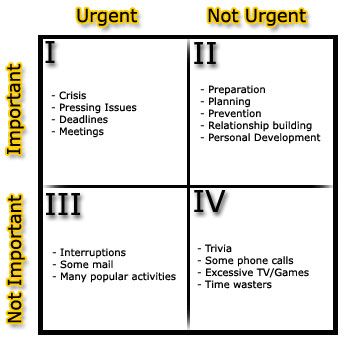
So on the horizontal axis we have things that are urgent, and not urgent.  A phone ringing is urgent, must be answered like, now.  Not urgent is reading a novel.  The book just sits there until it is picked up and opened.

The vertical axis are Important and Not important.  So it looks something like this


There are four quadrants.  Important/Urgent = Quadrant I  A very stressful place to be.  Things have to be done right now!

Urgent/Not Important = Quadrant III.  These things interrupt your routine, your well laid plans. How you view things, some of them could become quadrant I issues, but if they are not important they eat up your allocated time to complete something else.

Not Urgent/Not Important = Quadrant IV.  Things that are good, we all need down time, but if we do too much of them we find ourselves wasting time, and our productivity goes way down and we find ourselves not getting anything done we would like to.  However we are having a great time until things fall into Quadrant I and we are back to getting stressed.

Not Urgent/ Important = Quadrant II.  This is the important place, this is where things get done, relationships are built, where things that matter happen.  Time spent here makes our lives rich and fulfilling. However, because these things are not Urgent they can be done later.  A lot of my blogs have been on motivation and relationships and things that matter.  I believe working and living in Quadrant II is important.  I find that the demands on my time pull me into quadrant I and stress more often than I would like.  Over the next several weeks I plan on exploring each of these quadrants and give my own personal input from my own life experiences.

Again Steven Covey's book covers these in great detail.  I just use this as a resource.  I want to be sure I give credit where credit is due.

So draw your quadrants out and list the things in your life that fits in each of those quadrants. Ask yourself where you spend most of your time?  Where do you want to be?  How will you get there?  Oh, yes, that is a Quadrant II activity, isn't it?

Tuesday, October 2, 2012

BRoP Interview with Cat Torres


 Today's guest is Cat Torres.  This is Part V of her progressive interview across five blogs.  You can find her at these other spots as well.

Part 1 - Wednesday, September 26 @ Terri
Part 2 - Thursday, September 27 @ Teresa
Part 3- Friday, September 28 @ Emily
Part 4 - Monday, October 1 @ Sandra
Part 5 - Tuesday, October 2 @ Dean

Welcome to the Write Time Cat, ready to share some of what you've learned with the rest of us?  First off, tell us just a little bit about yourself.

I am in my mid-twenties and I graduated with a BA in Anthropology and a minor in Humanities. The name I go by is Cat and I love to write about the apocalypse, but not in the biblical sense of the word. Any sort of dystopian, end of the world stories seriously interest me. I guess it has a lot to do with being part of the rat race of life, trying to climb the great ladder of success.

Tell us about your route to success – how/when did you decide to self-publish? Did you query an agent first? How did you handle the editing, proofreading, cover design, etc.
I queried an agent first. During the querying process, for one reason or another, I decided to self-publish the book. After that, I asked around for editors and was recommended I try Faith Williams of The Atwater Group. She's fantastic! The cover design, like I said before, was done through Caterina Grandy and a friend. After that, self-publishing through Amazon and the other vendors wasn't too hard.

What are the most important elements of good writing?
The most important elements to good writing, in my opinion, are when I get an emotional response from the reader. Being eloquent and coming up with a great idea doesn't mean anything to me if my readers don't cry, laugh, get angry, and gasp throughout the book. I also like plot twists, so I also try to surprise the reader.

What tools are must-haves for writers?
Laptops and the internet. You have to have both to build your platform through social media, do research, and write a good manuscript.

Do you have any advice for other writers?
Have patience and success will come to you. 

What do you feel is the key to your success?
Working hard. I'm not a quitter, so if someone tells me I have to re-write a scene, I'll re-write it. 

Do you have anything specific that you want to say to your readers?
Don't give up and make true friends that share the same passion of writing.

What are your current / future project(s)?
I have a manuscript titled Death's List that I want to query and I'm almost finished with the first draft of Biohazard Tattoo, book #2 of the Zombie Trilogy.

Is there anything else you’d like to share?
Like what you write because if you don't like it, your readers won't either.


Other places you can find Cat on the web:
Website: http://caterinatorres.com/
Blog: http://caterinatorres.com/blog/
Facebook page: http://www.facebook.com/pages/Caterina-Torres/340181086022992
Goodreads author page: http://www.goodreads.com/author/show/5620895.Caterina_Torres
Twitter: https://twitter.com/CaterinaTorres
Amazon: http://www.amazon.com/Caterina-D-Torres/e/B0086O514C/ref=ntt_dp_epwbk_0
Smashwords: N/A
Other:

What format is your book(s) available in (print, e-book, audio book, etc.)?
e-book and print.

Monday, October 1, 2012

A Thought

Another jewel in my e-mail.  Had to share this one. 

Do more than belong: participate.
Do more than care: help.
Do more than believe: practice.
Do more than be fair: be kind.
Do more than forgive: forget.
Do more than dream: work.

-- William Arthur Ward

 I like the difference from passive to active.  To do the first half, you need to be doing the second part.  Reread the thought and make a plan on how to make it work in your life.  Good advice, a good thought.

Saturday, September 29, 2012

Alan Zimmerman writes about reading

Dr. Alan Zimmerman gives out Tuesday's Tip each week.  He is willing to share as long as he gets credit for what he wrote.  As writers we want people to read what we write.  So here is Dr. Zimmerman's post about reading...

"Some people will lie, cheat, steal and back-stab to get ahead... and to think, all they have to do is READ."Fortune Magazine
Ever since I taught at the university, I've always advocated a simple principle ... and that is ... you shouldn't waste your time learning things that won't make you happier or more successful. And throughout the hundreds of articles and books that I've published, I've described in great detail all those things you should learn ... things that WILL make you happier and more successful.

However, I need to apologize. I've been remiss. In all my writings, I've never addressed one of the most important things you MUST do to achieve extraordinary success at work as well as at home. Reading. You must become an excellent reader, no matter what age you are, and you must take time to read on a regular basis.

Why so?
1. Poor reading skills ... or a failure to keep on reading ... is a set-up for failure.

Don't ever be fooled by the stupid slogan that says, "Ignorance is bliss." As success researcher Jim Rohn said so well, "Ignorance is not bliss. Ignorance is poverty. Ignorance is devastation. Ignorance is tragedy. Ignorance is illness. It all stems from ignorance."

We know, for example, that there is a strong connection between your reading skills and your academic success. And there is a building body of evidence that shows a connection between your reading skills and reading activity and your business success as well as relationship success.

Obviously, there are a few people who manage to do very well for themselves without the ability to read, but they are by far the exception, as is evidenced by the headlines that flood the news outlets when the secret is revealed.

More than ever, those with reading deficiencies will be crippled by them ... far more than most physical disabilities they might have. With technology constantly advancing and phasing out menial jobs, those who can't read ... or can't read well ... or don't take the time to read ... will be hard pressed to find long-term work.

Worse yet, BeginToRead.com says illiteracy and crime are closely related. The Department of Justice states, "The link between academic failure and delinquency, violence, and crime is welded to reading failure." Over 70% of inmates in America’s prisons cannot read above a fourth grade level.

Simply put, if you can't read well or if you don't take time to read some of the great stuff coming out in every possible field, you are condemning yourself to a very bleak personal and professional future.

So please, please, please, don't cop out and say you're too busy to read what you need to learn to improve your life, your relationships, and your career. As Confucius said centuries ago, "No matter how busy you may think you are, you must find time for reading, or surrender yourself to self-chosen ignorance." And that is something you cannot afford.

If you will take the time to improve your reading skills and/or increase your reading time, you can expect to receive a host of benefits.
2. Reading success leads to academic success.

As educator and author Todd Christian observed, "It's not a coincidence that the students who excel academically are the same kids who seem to constantly have a novel as they walk from class to class. In my years of teaching, I cannot recall ever issuing a single failing grade to one of those book lovers."

Despite the irrefutable connection between reading success and academic success, it's somewhat amazing how little time our culture devotes to this vital skill. At present, parents and educators only have a few days ... a fraction of the child's whole life to get them set up for success.

A school year is approximately 140 days long, if you account for some vacation time and sick time. Kindergarten through the end of third grade is 4 years of schooling x 140 days or 560 days total. Your average life span is around 70 years or 25,550 days. In essence, all we have is about 2% of a child's lifetime to give them reading skills that will have an impact on them for the remaining 98% of their lives!

If you're a parent, get your kids to read more and more. And if you're a team leader, supervisor, or manager, get your team mates on a reading schedule. After all, the National Reading Panel 2000 concluded, "There is ample evidence that one of the major differences between poor and good readers is the difference in the quantity of total time they spend reading."
3. Reading activity leads to professional success.

W. Fusselman proclaimed, "Today a reader, tomorrow a leader." And President Harry S. Truman told everyone, "Not all readers are leaders, but all leaders are readers."

From first-hand experience I know that is the truth. As a professional speaker, I've had the opportunity to speak in hundreds and hundreds of organizations. And I've worked directly with many of their top leaders, and they're always talking about what they're reading and what they're learning.

Just this last week, I spoke at the all-company meeting for BeckAg, an incredibly innovative, tech-savy, agricultural communication company. As I was eating dinner with Stephanie Liska, the President of BeckAg, she turned to me and asked what was the best book I've read recently and shared the books that had the biggest impact on her personal and professional lives.

The experience was not an unusual one for me. Time after time, I've had Presidents, CEO's, CFO's, VP's, business owners and the like talk to me about the books they're reading and the difference it's making. I know for a fact that leaders are readers.

The lesson seems to be inescapable. If you want to get ahead, be better, or have more, you need to be an active reader.

4. Reading opens up a world of opportunities.


It was one of Walt Disney's secrets of success. He knew "there is more treasure in books than in all the pirate's loot on Treasure Island."

And Todd Christian went on to say, "One thing is undeniable: being able to read and comprehend at a high level not only improves your chances of success, but it opens up an infinite variety of avenues of success for your choosing."

You see ... if you are a poor reader or if you don't bother to read, you can get by in life and at work with a well-honed skill. But chances are, that's where you'll be stuck all your life. You'll be on narrow, single-lane road, with no exits. However, with the ability to learn on your own through reading, the roads to success can be as numerous and wide as a Texas road map. For those who read actively and enthusiastically, for those who are hungry to learn, every road branches into new possibilities, and their adaptability and broad range of knowledge will allow them to exit at any time and simply choose another route.

As Joseph Brodsky notes, "There are worse crimes than burning books. One of them is not reading them."

And finally, to make reading work for you, to make reading a part of your pathway to success, there's one more thing you've got to do.
5. Read before you need to.

When I finish my presentations at association or company meetings, a vast number of people will rush to the back of the room to buy my books. Of course that's nice. I'm hoping they'll read something that will make a big, positive, and lasting difference.

And just this last week, someone else e-mailed me, saying, "Our leaders are always talking about the importance of exceptional customer service, and I'm all for getting better at customer service. The question is ... 'HOW are we supposed to do it?' Then someone gave me a copy of your book on 'The Service Payoff: How Customer Service Champions Outserve And Outlast The Competition.' What a godsend. If only we had this material in our department a long time ago, we'd be so much further ahead today in building customer loyalty."

As I finish this "Tuesday Tip," you may be tempted to think that an article on reading for my 100,000 "Tuesday Tip" subscriber might seem rather elementary ... even beneath you. But don't ever minimize the importance of reading ... or even teaching reading to your kids or team mates. As Louisa Moats puts it, "Teaching reading IS rocket science."

And William Faulkner, one of the greatest writers of the 20th century, summarized his philosophy of success by saying, "Read, read, read."

Action:
Decide on one area in which you'd like to know more about or get better at. Read an hour a day on that topic and in three months you'll be an expert..
©2012 Reprinted with permission from Dr. Alan Zimmerman, a full-time professional speaker who specializes in attitude, motivation, and leadership programs that pay off.